
From Hours to Seconds: Alarm Routing for a 2,000+ Device Gas Distribution Network
How MetaPulse turned fragmented field telemetry across 2,000+ devices, manual handovers, and delayed alarm escalation into a structured response workflow for gas distribution operations.
- Revaz Chikashua
- Case Study
Before MetaPulse, one operational question was harder to answer than it should have been:
How long does it take for the right person to know that a field device has crossed a threshold?
In a gas distribution network, that delay changes the operating picture. A pressure reading drifts out of range. A meter stops communicating. A battery warning appears. A station reports late.
The event may be small. What it becomes - routine maintenance, a shift-handover issue, or a live operational risk - depends on how quickly it reaches someone who can act, and whether the team can later reconstruct what happened.
In the deployment described here, MetaPulse monitored 2,000+ field devices at a 10-second polling interval - a field estate that is still growing.
Based on Revaz Chikashua's field estimate of the baseline workflow, priority-alarm notification often took 45–60 minutes before the routed action path was complete. With MetaPulse, priority-alarm routing after detection reached the responsible team in under 10 seconds.
Stated conservatively, priority alarm notification moved from hours to seconds. That timing is not a universal SLA; it depends on each operator's devices, communication channels, alarm policy, and escalation rules.
That is the headline. The lesson underneath it is more useful: alarm routing has to be treated as incident-response infrastructure, not as a message-sending feature attached to a dashboard.
Before vs after
| Operating point | Before MetaPulse | After MetaPulse | Operational effect |
|---|---|---|---|
| Priority-alarm notification | 45–60 minutes in the baseline workflow, based on author field estimate | Under 10 seconds for priority routing after detection | Turns alarm response from manual awareness into a routed operational event |
| Field monitoring cadence | Fragmented checks across tools, calls, and local records | 2,000+ field devices monitored at a 10-second polling interval | Gives dispatchers a near-live operating picture across a large, growing field estate |
| Event traceability | Logs, calls, spreadsheets, and memory had to be compared after the fact | Threshold events, routing history, device activity, and user actions remain searchable | Makes incident review and handover faster to reconstruct |
| Shift handover | "What happened last night?" | "What is still open from last night?" | Moves the handover from storytelling to an actionable list |
Why was telemetry not enough?
The distribution team already had telemetry. Values were arriving. Devices were being checked. Operators knew the network.
The issue was not missing data. The issue was the path from field data to accountable action.
Some telemetry lived in one tool. Some device records lived somewhere else. Some updates moved through calls between dispatch and field teams. Shift handovers depended on shared documents that were only as complete as the last person who updated them. After a busy night, reconstructing one event could mean comparing logs, opening spreadsheets, and calling someone who was already off shift.
The result was a familiar operating pattern:
- Telemetry was visible, but fragmented.
- Threshold breaches could appear before the responsible team knew.
- Flow and metering values still required manual reconciliation.
- The chain of what happened, who saw it, who acted, and what changed was difficult to rebuild.
None of this is rare in distribution operations. That is exactly why it matters. When fragmented workflows become normal, the organization stops seeing the delay.
This post is not a compliance guide, but the operating logic is consistent with broader critical-infrastructure practice. For reference, NIST SP 800-82 Rev. 3 frames operational technology around systems that monitor or control physical processes, where performance, reliability, and safety requirements matter. For gas-distribution context, PHMSA's Gas Distribution Integrity Management Program describes the safety rationale behind distribution integrity-management requirements.
What did MetaPulse change in alarm routing?
MetaPulse was designed around three operational decisions.
First, a threshold breach should become a structured event. It should not depend on a dispatcher looking at the right screen at the right second. The event has to be routed to the right team, remain visible in the alarm center, and stay searchable later.
Second, the device registry has to live inside the workflow. Which device belongs to which station, which team owns which alarm category, and which parameters can be changed are not just configuration details. They are operational controls. When the registry drifts in a spreadsheet, alarm ownership becomes fragile.
Third, the audit trail has to support the work while the work is happening. Event history, parameter changes, connection logs, device activity, and user actions need to be preserved as part of the operating layer, not collected later from scattered evidence.
This is also where MetaPulse fits into the broader MetaEnergy stack. It is the alarm source for MetaFlow: MetaPulse detects and routes field events, and MetaFlow consumes them in its live dispatching and simulation workspace. MetaPulse owns field telemetry, device state, alarm routing, reconciliation, and traceability for gas distribution operations; MetaFlow puts those alarms in front of pipeline dispatchers alongside the hydraulic picture.
How does the four-layer MetaPulse architecture work?
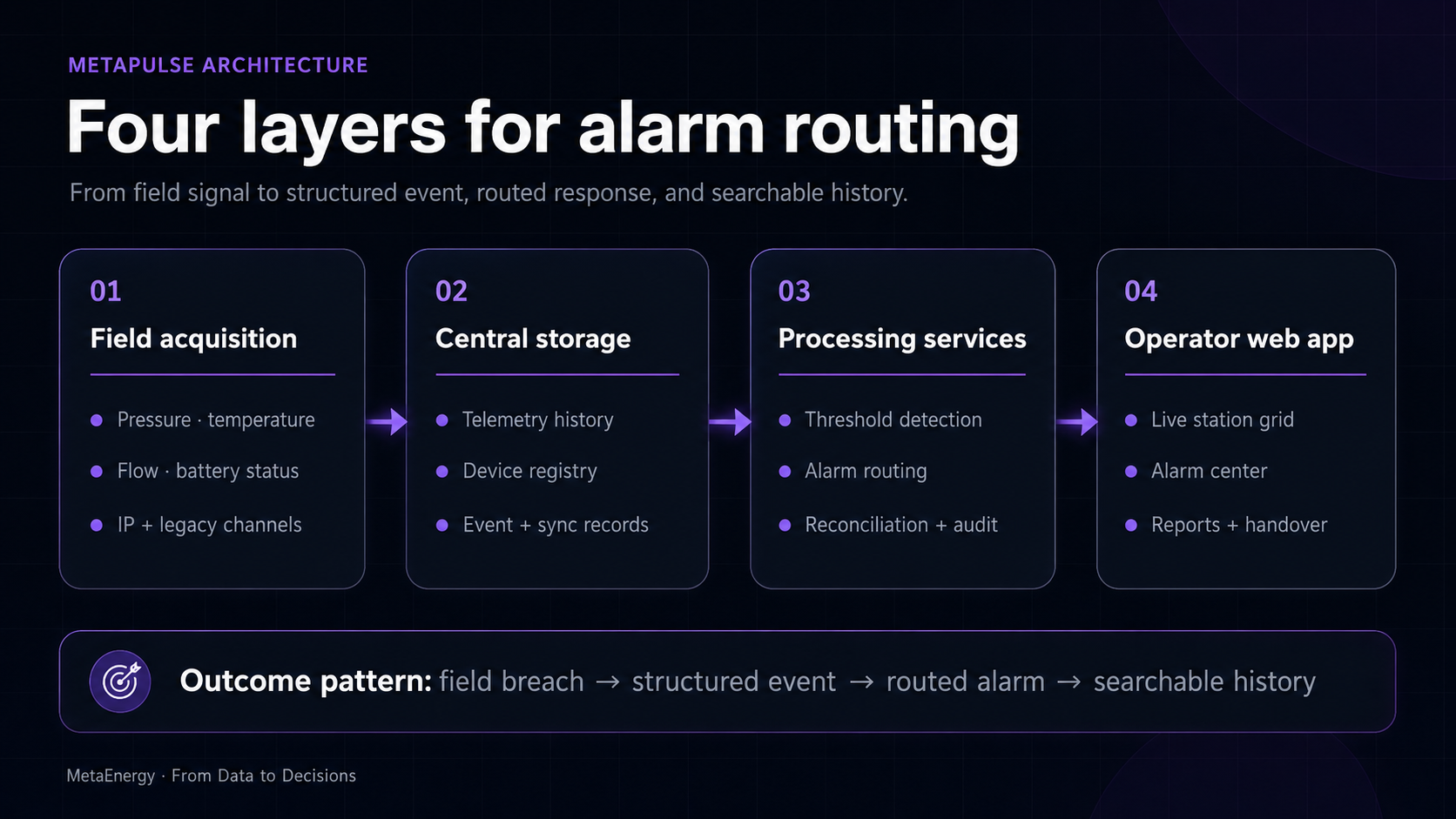
A clean architecture diagram is easy. A real gas distribution network is not.
Some devices communicate through modern IP-based paths. Others depend on legacy channels. Some values arrive reliably. Others become delayed, noisy, silent, or intermittent.
For a dispatcher, communication state is part of the operating picture. A missing value is not only a data-quality issue. A silent device is not only an integration warning. A delayed packet may be the first sign that the team needs to investigate the field path, not the pressure value.
MetaPulse was built around four connected layers:
Field acquisition collects pressure, temperature, flow, battery, connection status, and device communication data.
Central storage keeps telemetry history, the device registry, event logs, and synchronization records in one managed layer.
Processing services handle threshold detection, alarm routing, reconciliation, secure APIs, and audit logging.
Operator web application gives dispatchers the live station grid, alarm center, registry, reports, and shift-handover support.
The system had to work with the network as it was wired, not as a slide imagined it.
Why use a 10-second polling interval?
In telemetry projects, the natural instinct is to poll as fast as possible. That instinct can create bad operations.
A polling interval has to balance visibility, network load, device behavior, database writes, alert noise, and operator usefulness. Poll too slowly, and alarms arrive late. Poll too aggressively, and the system creates load without creating better decisions, while normal communication flickers begin to look like incidents.
In this deployment, 10 seconds was the practical balance. It was fast enough to make the dispatcher workspace feel live, frequent enough to support rapid alarm detection, and stable enough to avoid treating every signal variation as a crisis.
The target was useful polling: frequent enough to support action, quiet enough to preserve trust.
What happens after an alarm threshold breach?
The polling interval was not the main change. The important change was the sequence after a field value crossed a threshold.
Before, the workflow often depended on observation, calls, and manual follow-up. With MetaPulse, the sequence became structured:
Field breach → structured event → routed alarm → preserved history
A pressure value crosses its configured range. The system creates an event. The event is routed to the responsible team. Notification history is preserved. The dispatcher sees the alarm in the operational workspace. The event remains searchable for review.
That changes the question after an incident. Before, it was often: Who noticed this, and who called whom? After, it became: When did the event occur, how was it routed, and what happened next?
The first question is an archaeology project. The second has answers in the system.
What changed for dispatchers?
The practical improvement was not that dispatchers had more data on the screen. They had less hunting to do.
They no longer had to assemble the operational story from separate tools, phone calls, spreadsheets, and memory. Live device status, threshold events, alarm history, reconciliation outputs, and audit records became part of one workflow.
Shift handovers changed with it. The morning question stopped being "What happened last night?" and became "What is still open from last night?" That is a smaller question. It has a list behind it. In operations, that difference compounds.
The same principle reaches past telemetry into forecasting and network planning: the value is not only in the model or the dashboard, but in the operating workflow around it. That is why MetaEnergy also builds MetaCast for demand forecasting and Hydra for repeatable hydraulic calculations.
What does scale beyond 2,000 devices require?
Past 2,000 devices, the next expansion is never just "more endpoints."
More devices create more mappings to govern, more alarms to triage, more connection states to interpret, more parameter changes to track, and more reports to keep consistent. If the workflow is weak, scale exposes it.
A field estate this size - and still growing - requires registry governance to stay clean, escalation matrices to stay current, and connection-state monitoring to reliably distinguish a quiet device from a broken path. Reconciliation has to scale without becoming spreadsheet work again. Audit records have to remain searchable when the network grows beyond the team's ability to remember every station.
The first proof is that the workflow works. The real test is whether it stays quiet, traceable, and operationally useful as the device estate keeps growing - which, here, it is.
FAQ
How fast can MetaPulse route alarms?
In this deployment, automated routing moved priority-alarm notification from hours to seconds. Based on the author's field estimate, the baseline workflow often took 45–60 minutes, while MetaPulse routed priority alarms after detection in under 10 seconds. The exact result depends on the operator's communication channels, device behavior, alarm policy, and escalation rules.
Why not poll faster than 10 seconds?
Faster polling is not automatically better. A telemetry system has to balance network load, database writes, device behavior, signal stability, alert noise, and operator usefulness. In this deployment, 10 seconds was the practical operating balance.
How is the audit trail preserved?
MetaPulse preserves operational traceability by recording threshold events, alarm routing history, parameter changes, connection logs, device activity, and user actions inside the same operating workflow that dispatchers use during the shift.
Is 2,000+ devices a platform limit?
No. The 2,000+ figure describes the deployment discussed here, and the estate is still growing. Larger deployments require stronger registry governance, alarm-policy discipline, connection-state handling, reconciliation workflows, and reporting structure.
The bottom line
Gas distribution teams do not need one more passive dashboard.
They need a short, owned path from event to action: alarms that reach the right people, device records that stay consistent, reports that do not depend on memory, and handovers that survive without a phone call to the previous shift.
In this deployment, MetaPulse monitored 2,000+ field devices at a 10-second polling interval. For priority alarm categories, automated detection and routing moved notification time from hours to seconds.
Those numbers are not a universal recommendation. Device count, communication channels, polling interval, alarm policy, and escalation rules should be designed around each operator's network. What carries across every network is the design stance: build alarm routing as an operating layer for response, not as a message-sending add-on.
That is what MetaPulse was built to be - from hours to seconds.
From Data to Decisions.
About the author
Critical infrastructure technology executive with 18+ years of experience modernizing energy operations, combining operator insight with SCADA, telemetry, analytics, forecasting, and applied mathematics.